
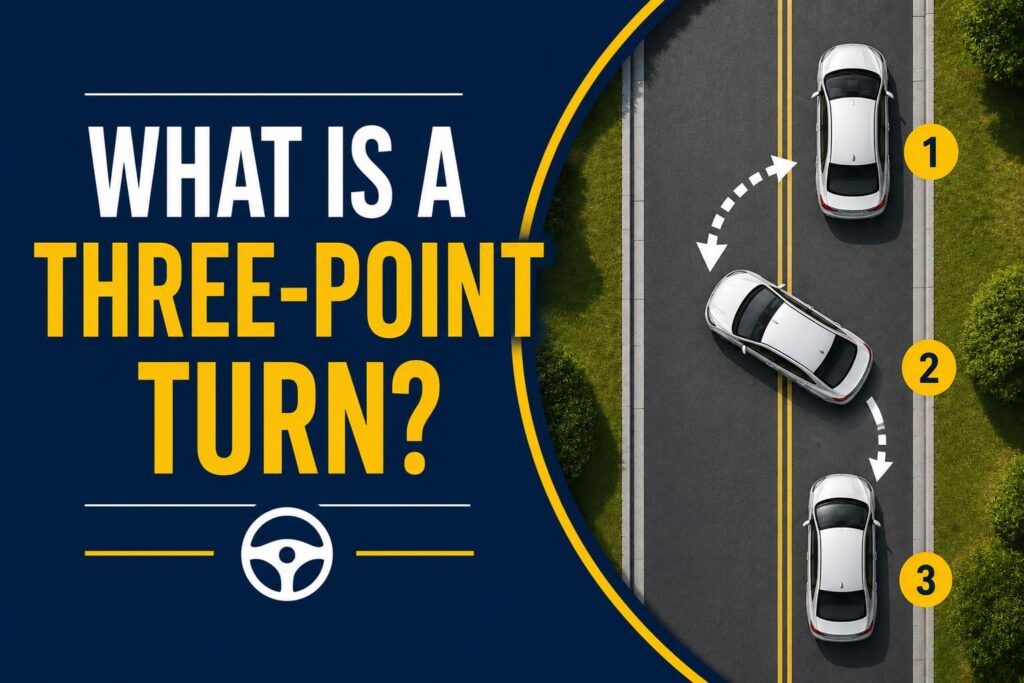
Learning how to perform a three-point turn is an important part of becoming a safe driver. It is this very basic driving skill that enables you to change the direction of your vehicle when the available space is so limited that it is impossible to make a full U-turn. Every learner driver should know how to perform this manoeuvre safely and confidently. At Best and Less Driving School, we help learners improve their driving skills and confidence
In essence, a three-point turn helps you turn your vehicle around so it faces the opposite direction. The reason behind the name “three-point” is that, usually, it takes three moves to complete the turn. The first thing you do is to drive your car forward to the other side of the road. Then, you reverse back to the other side of the road. Finally, you drive forward in the opposite direction. This manoeuvre is useful on very narrow streets where doing a U-turn is not safe.
Why is a Three-Point Turn Necessary?
A three-point turn is a very useful driving skill, as it enables drivers to switch directions safely when the space is limited. Working on this maneuver regularly will not only increase your confidence in driving but also improve your observation skills. These are the kind of skills that come in handy in numerous daily driving scenarios and overall make drivers safer on the roads.
How Do You Do a Three-Point Turn Safely?
Many learner drivers ask how to perform a three-point turn correctly and want to know the correct way to do a three-point turn. The steps to execute a three-point turn are not complicated if you just keep in mind the most significant steps. It is always best to keep safety as your first priority when doing a three-point turn. Besides continuous checking of the mirrors, drivers should check their blind spots, keep an eye on pedestrians and cyclists, and generally be aware of the traffic situation around them. Moving at a slow pace and being calm at the same time will make it easier for the driver to have control over the car, and at the same time, it will also lower the possibility of errors. Careful observation and patience are a couple of factors that, when combined, not only help avert incidents but also ensure the safety of all.
Common Mistakes Learners Make:
- Not remembering to look over their shoulders to check blind spots before they move the car.
- Reversing too quickly and losing control of the car.
- Forgetting to look in the mirrors and around the car during the whole maneuver.
- Failing to observe changing traffic conditions.
- Turning the steering wheel too fast.
- Using sharp steering motions instead of smooth ones.
- Staying too close to the kerb.
- Hitting or going over the pavement during the turn.
- Doing the maneuver too quickly instead of slowly and safely.
- Not keeping a good lookout when reversing.
Essential Tips for Performing a 3-Point Turn in NSW
When you are learning a 3-point turn in NSW, remember that the main point is to be safe while driving, not to finish the maneuver quickly. The teachers and examiners of driving sessions usually focus on your observation skills, safe decisions, the right use of indicators, the smoothness of your steering, and the overall control of your car.
Although it is always better to do the maneuver perfectly, showing safe driving behavior is sometimes the main thing. Keeping your cool, being aware of the changes around you, and controlling the vehicle will, without a doubt, lead you to a successful maneuver.
Practice Makes It Easier
Just like any other driving skill, doing a three-point turn gets less difficult the more you practice it. New drivers should begin practicing on quiet streets where there is very little traffic. In this way, they might be able to concentrate entirely on mastering the maneuver without getting distracted or stressed by the busy road conditions.
It is equally important not to get yourself worked up. A hurried approach frequently results in errors; however, taking one’s time will lead to better precision and self-assurance. Doing this quite often, of course, will not only build confidence and improve vehicle control but also quite a bit improve your level of comfort with the whole technique.
If you choose to get expert driving training, professional driving lessons can help you learn a three-point turn faster. In fact, professional instructors are capable of teaching the basics, pointing out the errors, and offering constructive criticism. Those who learn at Driving School St. Marys have a head start in their development because they receive professional instruction tailored to their specific needs.
Final Thoughts
Everyone learning to drive must know what a three-point turn is and how to do it properly. Besides helping the driver change direction safely when a U-turn is not possible, this maneuver also improves the driver’s control of the car and increases self-confidence.
Best and Less Driving School Blacktown is a perfect place to develop safe driving habits and important skills like three-point turns. With consistent practice, you’ll get to a level of confidence and responsibility as a driver capable of handling any situation on the roads of NSW. With regular practice and professional guidance, you can become a confident and responsible driver on NSW roads
FAQs (Frequently Asked Questions)
Q: What is a three-point turn?
A: It is a turning maneuver for vehicles that can be used when the road is too narrow for a regular U-turn.
Q: How do you do a three-point turn?
You start by going across the road, then reverse while turning the steering wheel the other way, and finally move ahead to face the opposite direction.
Q: Why is it called a three-point turn?
Because in most cases, it takes three movements: moving on, reversing, and going forward again.
Q: When should you use a three-point turn?
A three-point turn is only necessary if you want to go in the opposite direction and no space is available for making a U-turn.
Q: Is a three-point turn part of the NSW driving test?
It could be one of the elements checked for your ability to handle the vehicle safely and to show your observation skills.
Q: What should you check before performing a three-point turn?
Besides checking your mirrors and blind spots, be sure to look out for any other vehicles, cyclists, or pedestrians on the road.